Thursday, October 19, 2006

consanguinity


consanguinity –noun - Relationship by descent from a common ancestor; kinship; close relationship or connection.

Another five-syllable word!

I think the rule has been relaxed, but the Catholic church long forbade marriage in cases where the two parties had a common ancestor within seven generations.

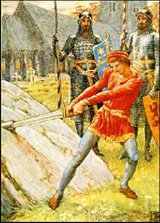
And now, for (I hope) your amusement, here's an excerpt in middle-English of publisher William Caxton's preface to Sir Thomas Malory's (1405-1471) Le Morte D'Arthur. My daughter flew into a rage after reading this; "He'd get an F in my school!" etc.

AFter that I had accomplysshed and fynysshed dyuers hystoryes as wel of contemplacyon as of other hystoryal and wordly actes of grete conquerours & prynces / And also certeyn bookes of ensaumples and doctryne / Many noble and dyuers gentylmen of thys royame of Englond camen and demaunded me many and oftymes / wherfore that I haue not do made & enprynte the noble hystorye of the saynt greal / and of the moost renomed crysten kyng / Fyrst and chyef of the thre best crysten and worthy / kyng Arthur / whyche ought moost to be remembred emonge vs englysshe men tofore al other crysten kynges / For it is notoyrly knowen thorugh the vnyuersal world / that there been ix worthy & the best that euer were / That is to wete thre paynyms / thre Iewes and thre crysten men / As for the paynyms they were tofore the Incarnacyon of Cryst / whiche were named / the fyrst Hector of Troye / of whome thystorye is comen bothe in balade and in prose / The second Alysaunder the grete / & the thyrd Iulyus Cezar Emperour of Rome of whome thystoryes ben wel kno and had / And as for the thre Iewes whyche also were tofore thyncarnacyon of our lord of whome the fyrst was Duc Iosue whyche brought the chyldren of Israhel in to the londe of byheste / The second Dauyd kyng of Iherusalem / & the thyrd Iudas Machabeus of these thre the byble reherceth al theyr noble hystoryes & actes / And sythe the sayd Incarnacyon haue ben thre noble crysten men stalled and admytted thorugh the vnyuersal world in to the nombre of the ix beste & worthy / of whome was fyrst the noble Arthur / whos noble actes I purpose to wryte in thys present book here folowyng / The second was Charlemayn or Charles the grete / of whome thystorye is had in many places bothe in frensshe and englysshe / and the thyrd and last was Godefray of boloyn / of whos actes & lyf I made a book vnto thexcellent prynce and kyng of noble memorye kyng Edward the fourth / the sayd noble Ientylmen Instantly requyred me temprynte thystorye of the sayd noble kyng and conquerour kyng Arthur / and of his knyghtes wyth thystorye of the saynt greal / and of the deth and endyng of the sayd Arthur / Affermyng that I out rather tenprynte his actes and noble feates / than of godefroye of boloyne / or ony the other eyght / consyderyng that he was a man borne wythin this royame and kyng and Emperour of the same / And that there ben in frensshe dyuers and many noble volumes of his actes / and also of his knyghtes / To whome I answerd / that dyuers men holde oppynyon / that there was no suche Arthur / and that alle suche bookes as been maad of hym / ben fayned and fables / by cause that somme cronycles make of hym no mencyon ne remembre hym noo thynge ne of his knyghtes / wherto they answerd / and one if specyal sayd / that in hym that shold say or thynke / that there was neuer suche a kynge callyd Arthur / myght wel be aretted grete folye and blyndenesse / For he sayd that there were many euydences of the contrarye / Fyrst ye may see his sepulture in the monasterye of Glastyngburye / And also in polycronycon in the v book the syxte chappytre / and in the seuenth book the xxiij chappytre/ where his body was buryed and after founden and translated in to the sayd monasterye / ye shal se also in thystorye of bochas in his book de casu principum / parte of his noble actes / and also of his falle / Also galfrydus in his brutysshe book recounteth his lyf / and in dyuers places of Englond / many remembraunces ben yet of hym and shall remayne perpetuelly / and also of his knyghtes.

Wednesday, October 18, 2006

scurrilous

scurrilous - adj - grossly or obscenely abusive; characterized by or using buffoonery; coarsely jocular or derisive.

I think of this word while reading parts of the 'Lord of the Flies', of which, unfortunately, I have no excerpt as an example. Perhaps Jack has one handy...

ex cathedra

ex cathedra - adj, adv - from the seat of authority; with authority: used esp. of those pronouncements of the pope that are considered infallible.

English is an eclectic language. First there were the Britons, then the Angles and Saxons came, then the Danes, then the Normans, and then - I can't go on; if you're interested, check out Melanie Phillips's book Londonistan. What is being done to Europe - or should I say Eurabia? - is one of the greatest civilizational (neologism?) crimes in history. At least the Romans put up a fight. (By the way, if what I've just said is racist or xenophobic, make the most of it. One thing I'll say for Cultural Marxism is that it's a great vocabulary builder.)

Tuesday, October 17, 2006

candid

candid - adj - frank; outspoken; open and sincere

The opposite of disingenuous.

disingenuous

disingenuous – adj - Lacking in frankness, candor, or sincerity; falsely or hypocritically ingenuous; insincere.

This is one of our more frequently used five-syllable words.

Tangent: My life took a turn for the better once I finally learned to say two things:
1) "I don't know."
2) "I was wrong."
Now if only my older son would learn to say them there would be a massive change in the quality of both our lives. (Come to think of it, he often strikes me as disingenuous; maybe this isn't a tangent after all.)

Monday, October 16, 2006

indomitable

indomitable - adj - incapable of being subdued or overcome; unconquerable


Tagging along with Jack here, in a different way. Often, an austere person is seen as indomitable either due to their sternness, or strict discipline.

austere


austere – adj - Severe in manner or appearance; uncompromising; strict; forbidding.

Tangent: Is it acceptable to lie when it's done on behalf of a worthy cause? On the other hand, why would a worthy cause need lies to support it?

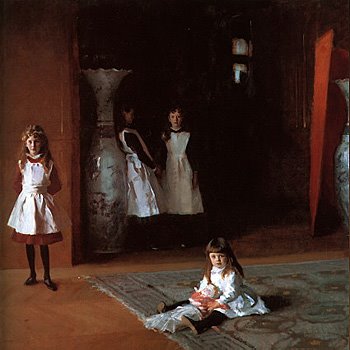
Tangent: The painting is John Singer Sargent's portrait of the daughters of Edward Darly Boit (1882). Recent commentary on this painting by a tenured academic whose name I've forgotten provides some insight into what's wrong with modern humanities. The appreciation of beauty has been cast aside in favor of the search for sexism, racism, homophobia, classism, etc. In other words, works are judged on their conformity to standards set by cultural Marxism, better known as political correctness.

First, the claim is made that the girls are mere objects. The reasoning is that they have no names! Well, a minute's search on the internet established that they do have names; standing left-to-right are Mary Louise (age eight), Florence (14), and Jane (12); the one sitting is Julia (four).

Second, the girls are wearing uniforms! (I'm not making this up.) As a matter of fact, they're wearing standard Gilded Age girl clothes: pinafores and opaque stockings. If the men in the house had been included in the portrait, you might conclude that they were wearing uniforms too.

Third - and most important - look at little Julia. Notice that her legs are spread, and what's that between them? A baby! Get it? Huh? Huh? Huh?

God save us.

Friday, October 13, 2006

concinnity

concinnity - noun - internal harmony or fitness in the adaptation of parts to a whole or to each other; elegance, especially of the literary style.

See, I would have used this to describe one of the most beautiful forms found in creation, however it seems this word applies more to literature.

de riguer


de rigueur - adj - Required by the current fashion or custom; socially obligatory.

This term was in very common use when I was growing up in New York. I now wonder how this bit of French got started in an area mostly populated by blue collar Irish and Italians. As Nelson Muntz said, "It's one of those things we'll never know, like what's the square root of a million."

Thursday, October 12, 2006

tchotchke

tchotchke - noun - a trinket; a knicknack

... paddy whack, give that dog a bone....

brutalize


brutalize - v - To make cruel, harsh, or unfeeling; to treat cruelly or harshly.

This is one of my uglier entries.

I am not an enthusiast for true crime stories, but three murder cases have long fascinated me, viz., the Jack the Ripper murders of 1888, the Lizzie Border case of 1892, and the Black Dahlia horror of 1947. What all three cases have in common is that there is doubt about the identity of the murderer. I am now satisfied that Lizzie Borden did indeed murder her father Andrew and her stepmpther Abby on that hot August day in Fall River, Massachusetts. I am also persuaded, after reviewing research by novelist Patricia Cornwell, that impressionist painter Walter Sickert was the Ripper. The one case that remains a mystery is the Black Dahlia murder. (Warning: This post may be unsettling from this point on; I have often wished I'd never hear of the Black Dahlia.)

On a January morning in 1947, a mother and her three-year-old daughter were walking past a field in Los Angeles when the mother saw what she thought was a broken mannequin. On closer inspection, the mannequin turned out to be the naked body of a young woman. The body had been cut in half at the waist and been horribly - what's the right word? - mutilated? defiled? Words fail me. The corpse was identified as that of a pretty Massachusetts girl named Elizabeth Short. Betty Short was in her mid-20s; she had come to Hollywood, like many other pretty girls, to get into movies. She did attain fame, but not the kind she sought. The autopsy revealed that she had been tortured to death over a period of 24 to 36 hours. Her body had then been sawed in half, washed clean of blood, and dumped in that field.

The police launched a massive manhunt, a virtually door-to-door search for the murderer, without success. The identity of the Black Dahlia killer is still a mystery.

The case has inspired at least two novels, John Gregory Dunne's True Confessions and James Ellroy's The Black Dahlia, both of which have been made into movies. I've seen True Confessions (with Robert Duvall and Robert De Niro), but I'm actually afraid of watching The Black Dahlia. If either of you have seen it, I'd love to hear your review.

Wednesday, October 11, 2006

disparage

disparage - verb - to speak of or treat slightingly; depreciate; belittle; to bring reproach or discredit upon; lower the estimation of

magus


magus - n - A member of the Zoroastrian priestly caste of the Medes and Persians; In the New Testament, one of the wise men from the East, traditionally held to be three, who traveled to Bethlehem to pay homage to the infant Jesus; A sorcerer; a magician.

The three magi are an integral part of the Christmas story. Guided by a star they came to Bethlehem bearing gifts of gold, frankincense, and myrrh for the newborn King. I miss them as I miss the rest of the Nativity stories and songs that were not so long ago associated with what has now become a generic winter holiday. Jingle Bells and Frosty the Snowman are still acceptable, but Silent Night and O Come All Ye Faithful have been banished from the airwaves. I find it interesting that the last-named song was commonly sung in Latin (Adeste Fideles), at least in the New York metropolitan area where I grew up. As for the three magi, they have a Christmas carol of their own:

We three kings of Orient are;
Bearing gifts we traverse afar,
Field and fountain, moor and mountain,
Following yonder star.

(Refrain)
O star of wonder, star of light,
Star with royal beauty bright,
Westward leading, still proceeding,
Guide us to thy perfect light.

Born a King on Bethlehem’s plain
Gold I bring to crown Him again,
King forever, ceasing never,
Over us all to reign.

(Refrain)

Frankincense to offer have I;
Incense owns a Deity nigh;
Prayer and praising, voices raising,
Worshipping God on high.

(Refrain)

Myrrh is mine, its bitter perfume
Breathes a life of gathering gloom;
Sorrowing, sighing, bleeding, dying,
Sealed in the stone cold tomb.

(Refrain)

Glorious now behold Him arise;
King and God and sacrifice;
Alleluia, Alleluia,
Sounds through the earth and skies.

(Refrain)

Tuesday, October 10, 2006

decry

decry - verb - to speak disparagingly of; denounce as faulty or worthless; express censure of; to condemn or depreciate by proclamation, as foreign or obsolete coins.

Monday, October 09, 2006

perorate

perorate - verb - to conclude or sum up a long discourse; to speak or expound at length; to declaim

amour propre


amour propre - n - Self-love; self-respect; feelings of excessive prode.

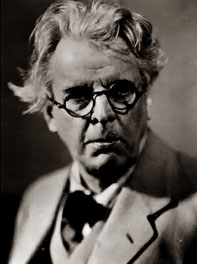
Tangent: Robert Bourke wrote a book, Slouching Toward Gomorrah, in which he identified radical individualism and radical egalitarianism as root causes of our societal ills. The title is a take-off on a line from a poem by William Butler Yeats (1865-1939).

The Second Coming

TURNING and turning in the widening gyre
The falcon cannot hear the falconer;
Things fall apart; the centre cannot hold;
Mere anarchy is loosed upon the world,
The blood-dimmed tide is loosed, and everywhere
The ceremony of innocence is drowned;
The best lack all conviction, while the worst
Are full of passionate intensity.

Surely some revelation is at hand;
Surely the Second Coming is at hand.
The Second Coming!
Hardly are those words out
When a vast image out of Spiritus Mundi
Troubles my sight: somewhere in sands of the desert
A shape with lion body and the head of a man,
A gaze blank and pitiless as the sun,
Is moving its slow thighs, while all about it
Reel shadows of the indignant desert birds.
The darkness drops again; but now I know
That twenty centuries of stony sleep
Were vexed to nightmare by a rocking cradle,
And what rough beast, its hour come round at last,
Slouches towards Bethlehem to be born?

Friday, October 06, 2006

stanch

stanch - verb - to stop the flowing of; to check in its course

cryptic


cryptic - adj - Mysterious in meaning; puzzling; ambiguous.

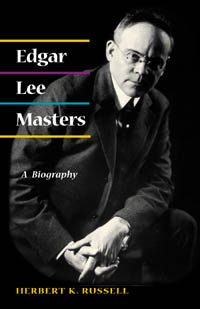
I have nothing to say about today's word, so I'll put in a plug for Edgar Lee Masters's "Spoon River Anthology," which is notable for, among other things, being one of the few poetry books that was a national bestseller, and which continues to sell today. It's a series autobiographical epitaphs for the people of Spoon River, a fictitious Illinois town. Here are two of my favorites:

Emily Sparks

Where is my boy, my boy—
In what far part of the world?
The boy I loved best of all in the school?—
I, the teacher, the old maid, the virgin heart,
Who made them all my children.
Did I know my boy aright,
Thinking of him as spirit aflame,
Active, ever aspiring?
Oh, boy, boy, for whom I prayed and prayed
In many a watchful hour at night,
Do you remember the letter I wrote you
Of the beautiful love of Christ?
And whether you ever took it or not,
My boy, wherever you are,
Work for your soul’s sake,
That all the clay of you, all of the dross of you,
May yield to the fire of you,
Till the fire is nothing but light!...
Nothing but light!

Knowlt Hoheimer


I WAS the first fruits of the battle of Missionary Ridge.
When I felt the bullet enter my heart
I wished I had staid at home and gone to jail
For stealing the hogs of Curl Trenary,
Instead of running away and joining the army.
Rather a thousand times the country jail
Than to lie under this marble figure with wings,
And this granite pedestal
Bearing the words, ”Pro Patria.”
What do they mean, anyway?

(Notes: The Battle of Missionary Ridge outside Chattanooga, Tennessee, was fought between Union forces commanded by Major General Ulysses S Grant and Confederate forces commanded by General Braxton Bragg. "Pro patria" means "for country;" it comes from a line by the Roman poet Horace [Quintus Horatius Flaccus, 65 BC - 8 BC]: "Dulce et decorum pro patria mori est [It is sweet and fitting to die for one's country].")

Thursday, October 05, 2006

opprobrium

opprobrium - noun - disgrace; infamy; reproach mingled with contempt; a cause or object of reproach or disgrace.

I love that definition - reproach mingled with contempt. What a cool way to flavor this word. Anyway, this one comes from recent history channel shows about the Knights Templar, especially at and after 1307.

cenacle


cenacle - n - The room where the Last Supper took place; A clique or circle, especially of writers; A small dining room, usually on an upper floor.

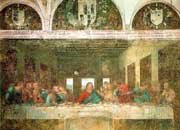
The picture is Leonardo da Vinci's Last Supper (1498); it shows the reaction of the apostles to Christ's prediction that one of them would betray Him.