harangue - noun - a speech addressed to a large public assembly; a noisy pompous speech; a rant
Kind of like my post on quality earlier...
Tuesday, November 07, 2006

Monday, November 06, 2006
gestalt
gestalt - noun - a configuration, pattern or organized field having specific properties that cannot be derived from the summation of its component parts; a unified whole
synecdoche
synecdoche – n - A figure of speech in which a part is used for the whole or the whole for a part, the special for the general or the general for the special.
Prime examples would be the popular Civil War command to give the enemy the "cold steel" (general), meaning to use the bayonet (particular); the naval command "All 'hands' (part) on deck," meaning all crew men (whole) on deck; etc.
Prime examples would be the popular Civil War command to give the enemy the "cold steel" (general), meaning to use the bayonet (particular); the naval command "All 'hands' (part) on deck," meaning all crew men (whole) on deck; etc.
Friday, November 03, 2006
fillip
fillip - verb - to strike with the nail of a finger snapped from the end of the thumb.
When I was a kid, we called this behavior a thump.
When I was a kid, we called this behavior a thump.
Extreme Unction
extreme unction n - The rite formerly in practice in which a Roman Catholic priest anointed and prayed for a sick or injured person, especially one in danger of death. In 1972 the name and rite were changed to Anointing of the Sick.
I was inspired to use this word after talking to a Baptist friend who believed that the Catholic Church taught that those who died without receiving Extreme Unction (also known as last rites) would be condemned to hell. The woman I spoke to is a good Christian, but she was badly misinformed. I would guess that most Catholics die without receiving the last rites and without even having an opportunity to recieve them, e.g., soldiers killed in combat, people killed in accidents, people who die from sudden heart attacks (like my father), etc.
The Catholics recognize seven sacraments: baptism, confirmation, holy eucharist (communion), penance, extreme unction (anointing of the sick), holy orders (becoming a priest, etc.), and matrimony. Lutherans recognize only baptism, holy eucharist, and penance. I don't know about other denominations, but I'd love to find out.
(I've been considering the possibility of another ecumenical council, this time with the objective of reuniting all Christian churches. What we have in common is so much more important than what divides us. The first step would be to have the pope revert to being the bishop of Rome. Any thoughts on this?)
I was inspired to use this word after talking to a Baptist friend who believed that the Catholic Church taught that those who died without receiving Extreme Unction (also known as last rites) would be condemned to hell. The woman I spoke to is a good Christian, but she was badly misinformed. I would guess that most Catholics die without receiving the last rites and without even having an opportunity to recieve them, e.g., soldiers killed in combat, people killed in accidents, people who die from sudden heart attacks (like my father), etc.
The Catholics recognize seven sacraments: baptism, confirmation, holy eucharist (communion), penance, extreme unction (anointing of the sick), holy orders (becoming a priest, etc.), and matrimony. Lutherans recognize only baptism, holy eucharist, and penance. I don't know about other denominations, but I'd love to find out.
(I've been considering the possibility of another ecumenical council, this time with the objective of reuniting all Christian churches. What we have in common is so much more important than what divides us. The first step would be to have the pope revert to being the bishop of Rome. Any thoughts on this?)
Thursday, November 02, 2006
ziggurat
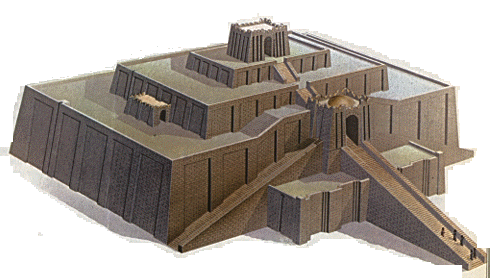
ziggurat – n - A temple of Sumerian origin in the form of a pyramidal tower, consisting of a number of stories and having about the outside a broad ascent winding round the structure, presenting the appearance of a series of terraces.
I'm not going to try to match WolfJB's last entry. I'll just note that the Tower of Babel is the most famous example of a ziggurat and let it go at that. (The picture shows a reconstruction of Ur-Nammo, completed in the early 21st century BC, in what is now Iraq.)
Wednesday, November 01, 2006
quality
quality - noun - character with respect to fineness, or grade of excellence; high grade; superiority; excellence; native excellence or superiority
Have you noticed how this word, in my generation anyway, seems to be something which can't be quantitatively defined, and therefore is unattainable?
It wasn't that long ago when Cadillac was the premier car built in the world. So much so, in fact, that it became an adjective for describing other things of high quality. A real cadillac of a gun, for example, was finely made with a smooth action and high accuracy. Attention detail in every facet. Before Cadillac, it was Buick.
Then came the dark ages of automation, the Vietnam war, the 1960's and downsizing.
Remember the times when a man's word was as good as a contract in paper and a handshake was as binding as the signature thereon? You knew you could count on that person to follow through on the commitment made by just a statement and a handshake. I can remember my dad telling me the most important thing I had to give someone else was my 'word', meaning my commitment to accomplish a task.
Then came the dark ages of automation, the 1980's, robots, a global economy and downsizing.
And what about those days when excellence was a way of life? We put men on the moon. We did it with people who had tested every component of those spacecraft repeatedly enough to define them as perfect. And even when they failed, there was a backup system the engineers on the ground could tell the guys in space to use while they debugged the failed system. Recall the moon is 186,000 miles from the earth. How about that for a long distance tech support call! Who remembers the old Ford commercials declaiming 'Quality is job 1', yet for most people at that time, Ford stood for Fix Or Repair Daily.
Then came the dark ages of consumerism, a global economy and laziness.
As a culture of people we have become more aware of our bottom line and outsourcing to other countries to lower cost at the expense of quality and expecting people here to just accept it (which we have) and go on with life. It's no longer important to companies to not screw stuff up. They just go on and we all wonder where our product is or why we don't have it, but then just shrug and go on because that's life. If we do call the company that screwed up, we get the nice voice on the other end that apologizes for the inconvenience and will send out, or fix our problem at their next available opportunity. They do it so often, they even have a script for it. They do it so often they train their lowliest phone people how to read the script with the correct tone of voice, and if you need to get the problem resolved right now, you have to go up the food chain four or five levels. We have become a lazy, complacent people. We are too lazy to do for ourselves when we can just hire illegal (uh, I mean undocumented) workers for less than half the cost of paying someone else to do a quality job. We have lost touch with what has, in a lot of ways, made America great. We are so blasted stinking rich around here we can live with high debt ratios just to have luxury of being lazy. No longer is someone's 'word' good enough, we have to have complex legal instruments describing exactly how we are going to screw the other guy when the other guy doesn't deliver on what they said they are going to do.
In the past, the words 'good enough' just weren't good enough. Excellence was the bar and quality was it's measure. These days, mediocrity is the bar and never mind measuring it.
Have you noticed how this word, in my generation anyway, seems to be something which can't be quantitatively defined, and therefore is unattainable?
It wasn't that long ago when Cadillac was the premier car built in the world. So much so, in fact, that it became an adjective for describing other things of high quality. A real cadillac of a gun, for example, was finely made with a smooth action and high accuracy. Attention detail in every facet. Before Cadillac, it was Buick.
Then came the dark ages of automation, the Vietnam war, the 1960's and downsizing.
Remember the times when a man's word was as good as a contract in paper and a handshake was as binding as the signature thereon? You knew you could count on that person to follow through on the commitment made by just a statement and a handshake. I can remember my dad telling me the most important thing I had to give someone else was my 'word', meaning my commitment to accomplish a task.
Then came the dark ages of automation, the 1980's, robots, a global economy and downsizing.
And what about those days when excellence was a way of life? We put men on the moon. We did it with people who had tested every component of those spacecraft repeatedly enough to define them as perfect. And even when they failed, there was a backup system the engineers on the ground could tell the guys in space to use while they debugged the failed system. Recall the moon is 186,000 miles from the earth. How about that for a long distance tech support call! Who remembers the old Ford commercials declaiming 'Quality is job 1', yet for most people at that time, Ford stood for Fix Or Repair Daily.
Then came the dark ages of consumerism, a global economy and laziness.
As a culture of people we have become more aware of our bottom line and outsourcing to other countries to lower cost at the expense of quality and expecting people here to just accept it (which we have) and go on with life. It's no longer important to companies to not screw stuff up. They just go on and we all wonder where our product is or why we don't have it, but then just shrug and go on because that's life. If we do call the company that screwed up, we get the nice voice on the other end that apologizes for the inconvenience and will send out, or fix our problem at their next available opportunity. They do it so often, they even have a script for it. They do it so often they train their lowliest phone people how to read the script with the correct tone of voice, and if you need to get the problem resolved right now, you have to go up the food chain four or five levels. We have become a lazy, complacent people. We are too lazy to do for ourselves when we can just hire illegal (uh, I mean undocumented) workers for less than half the cost of paying someone else to do a quality job. We have lost touch with what has, in a lot of ways, made America great. We are so blasted stinking rich around here we can live with high debt ratios just to have luxury of being lazy. No longer is someone's 'word' good enough, we have to have complex legal instruments describing exactly how we are going to screw the other guy when the other guy doesn't deliver on what they said they are going to do.
In the past, the words 'good enough' just weren't good enough. Excellence was the bar and quality was it's measure. These days, mediocrity is the bar and never mind measuring it.
doublet
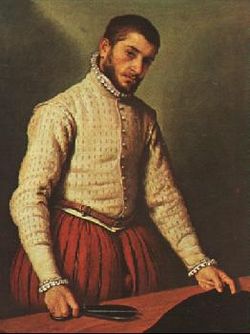
doublet – n - A close-fitting outer garment, with or without sleeves and sometimes having a short skirt, worn by men in the Renaissance; an undergarment, quilted and reinforced with mail, worn beneath armor.
Look for more Three Musketeers related words in the near future. Dumas's novel is exhibit A in my argument that classic literature need not be dull.
Tuesday, October 31, 2006
ague
ague - noun - a fit of fever or shivering or shaking chills, accompanied by malaise, pains in the bones and joints, etc.; chill
quaint
quaint –adj - Having an old-fashioned attractiveness or charm; oddly picturesque; strange, peculiar, or unusual in an interesting, pleasing, or amusing way.
I have nothing to say about today's word other than to note that I find quaint things, whether houses, ideas, or people, very likeable.
I have nothing to say about today's word other than to note that I find quaint things, whether houses, ideas, or people, very likeable.
Monday, October 30, 2006
impudent
impudent – adj - Of, pertaining to, or characterized by impertinence or effrontery.
I was thinking about my misspent youth over the weekend, and I recalled that impudence was a charge often laid against us when we were young, e.g., "Of all the impudent tricks, this one takes the cake!"
Aside to Jeff: Dumas wrote two sequels to The Three Musketeers, Twenty Years After and The Man in the Iron Mask. Have you read either of them, and, if you have, what did you think? I got TTM for Christmas in 1960, and I almost literally couldn't put it down; I remember reading it in the car, in my room (under the covers with a flashlight), and even soaking in the bathtub. As soon as I finished, I was off to the library for TYA, but I just couldn't get into it. All I remember is that one of the musketeers (Aramis?) had taken Holy Orders and become a monk or priest. I was just a kid at the time, so maybe I'd like it better now. How say you?
Still another tangent: I've just realized that one reason I never excel at anything is that I have too many interests and am constantly bouncing from one to the other. For example, right now I'm moving back and forth among church history, medieval culture, Alexander Dumas (pere, not fils), finishing Shakespeare's plays, poems, and sonnets, and English literature in general (which includes American literature, so maybe I should say English language literature). And that's aside from raising two children and earning a living. What's an aspiring polymath to do?
I was thinking about my misspent youth over the weekend, and I recalled that impudence was a charge often laid against us when we were young, e.g., "Of all the impudent tricks, this one takes the cake!"
Aside to Jeff: Dumas wrote two sequels to The Three Musketeers, Twenty Years After and The Man in the Iron Mask. Have you read either of them, and, if you have, what did you think? I got TTM for Christmas in 1960, and I almost literally couldn't put it down; I remember reading it in the car, in my room (under the covers with a flashlight), and even soaking in the bathtub. As soon as I finished, I was off to the library for TYA, but I just couldn't get into it. All I remember is that one of the musketeers (Aramis?) had taken Holy Orders and become a monk or priest. I was just a kid at the time, so maybe I'd like it better now. How say you?
Still another tangent: I've just realized that one reason I never excel at anything is that I have too many interests and am constantly bouncing from one to the other. For example, right now I'm moving back and forth among church history, medieval culture, Alexander Dumas (pere, not fils), finishing Shakespeare's plays, poems, and sonnets, and English literature in general (which includes American literature, so maybe I should say English language literature). And that's aside from raising two children and earning a living. What's an aspiring polymath to do?
Friday, October 27, 2006
stertorous
stertorous - adj - characterized by heavy snoring
After a long week of work, I nearly feel as if I'd been running a marathon, so my sleep must be characterized by this type of breathing. We had the unfortunate event of letting go of one of the contractors, so I have had to pick up his work. Hence my absence on this list recently. I hope to return in full force next week.
After a long week of work, I nearly feel as if I'd been running a marathon, so my sleep must be characterized by this type of breathing. We had the unfortunate event of letting go of one of the contractors, so I have had to pick up his work. Hence my absence on this list recently. I hope to return in full force next week.
syncretism
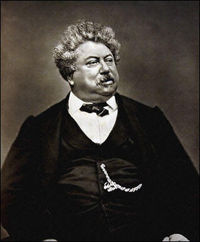
syncretism – n - The attempted reconciliation or union of different or opposing principles, practices, or parties, as in philosophy or religion.
I suppose a religious example might be the Anglican religion, which was at one time the 'via media' ('middle way' as C S Lewis described it) between Catholicism and most Protestant churches. In philosophy, Immanuel Kant's Critique of Pure Reason attempted to reconcile rationalism and empiricism.
Today's tangent is directed at Jeff, although it interested me as much as I hope it will interest Natalie too. The London Times has a review by Antonia Fraser of a new translation of Alexander Dumas's classic, The Three Musketeers; she's inspired me to give the novel a long overdue re-reading. Here's a sample:
"Why is Dumas’ tale imperishable? First The Three Musketeers has strong elements of a fairytale: one founded on a quest. D’Artagnan is the provincial youth who sets out on a despicable yellow nag, armed with nothing but a letter of introduction to M de Tréville, head of the King’s Musketeers – a letter that is almost immediately stolen. He is handsome, naive and aggressive. It goes without saying that the three musketeers, Athos, Aramis and Porthos, are expert swordsmen, and extremely quick on the draw. D’Artagnan, no slouch himself — “you walking sword blade” is a not inappropriate comment — has scarcely encountered them when he has challenged all three to a series of duels. He finally wins through to his heart’s desire and becomes a musketeer.
"Secondly, the plotting is good and the pace terrific. Although we know from the history books that the Duke of Buckingham will be assassinated by a man named John Felton, we still thrill to the tale of Felton’s seduction by the wicked Milady and hope that she will somehow be frustrated."
Check out the whole thing at http://www.timesonline.co.uk/article/0,,923-2400897,00.html.
Wednesday, October 25, 2006
equivocate
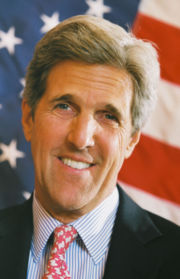
equivocate – v - To use ambiguous or unclear expressions, usually to avoid commitment or in order to mislead; prevaricate or hedge.
This is the essence of modern political speech. A prime example would be John Kerry's answer to a question on abortion during the 2004 sound-bite-exchange. He claimed that as a Roman Catholic he disapproved, but he didn't feel he could impose his personal morality on others. Even forgetting the fact that many if not most laws impose morality on others, his answer was laughable. Here's a man who claims to be a Catholic, but who divorced his first wife, lived with his current wife before marrying her, and, when he did finally get around to that technicality, married her in a civil ceremony. Need I mention that every one of those acts violated Catholic teachings? In the eyes of the church he's not married; he also has at least three sins to confess if he ever finds it convenient to indulge in the sacrament of Penance. More than incidentally, if he receives Communion without Penance, he can add another mortal sin to the list. At least he was capable of putting together a coherent English sentence.
Monday, October 23, 2006
orgiastic
orgiastic - adj - of, pertaining to, or having the nature of an orgy; tending to arouse or excite unrestrained emotion; reaching a peak of emotional intensity, often of an ecstatic nature and frequently expressed by uninhibited behavior
I'll just let your imagination roam on this one...
I'll just let your imagination roam on this one...
serging
serging - the process of overcasting the raw edges of a piece of fabric (as a carpet) to prevent raveling
Serging and overcasting are similar, so here's what wikipedia says about serging that also throws in a little about overcasting:
Serging: trimming the edge of fabric and overcasting all in one step, sometimes with the option of stitching as well. Also used for creating artistic effects. Serging is ideal for stretchy fabrics or fabrics that should have neat edges. Virtually all commercially-sold clothing is completely made with one or more specialized industrial sergers.
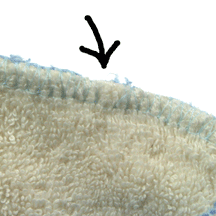
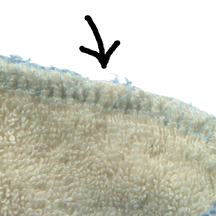
Here's where some serging has come undone:
Serging and overcasting are similar, so here's what wikipedia says about serging that also throws in a little about overcasting:
Serging: trimming the edge of fabric and overcasting all in one step, sometimes with the option of stitching as well. Also used for creating artistic effects. Serging is ideal for stretchy fabrics or fabrics that should have neat edges. Virtually all commercially-sold clothing is completely made with one or more specialized industrial sergers.
Here's where some serging has come undone:
Friday, October 20, 2006
ex officio

ex officio - adv, adj - By virtue of office or position.
I have nothing in particular to say about this term, so I'll give an example and move on: The president of the United States is ex officio commander in chief of the military.
Now on to Dante Alighieri (1265-1321). The most widely read part of his Comedy is Inferno (you should read the whole thing), and the best known part of Inferno is the inscription above the gates of Hell:
Through me you pass into the city of woe:
Through me you pass into eternal pain:
Through me among the people lost for aye.
Justice the founder of my fabric mov'd:
To rear me was the task of power divine,
Supremest wisdom, and primeval love.
Before me things create were none,
save thingsEternal, and eternal I endure.
All hope abandon ye who enter here.
Dante's Hell has nine circles, each more terrifying than the last. The ninth circle is reserved for traitors. There we find Satan gnawing eternally on Judas, Brutus, and Cassius.
I've read the Comedy twice, and I'm not done with it yet. I've also read the Inferno with my son Michael as part of his education. There are many good English translations; I use the one by Mark Musa in the Portable Dante. Check out the notes and commentary provided before you select a version to read; the poem contains names and references that would have been common knowledge to Dante's contemporaries, but which a modern reader (myself included) probably won't get.
Dante's Comedy gives a powerful picture of the world as seen by an educated man of the High Middle Ages. I can't recommend it too strongly. (Note: The poem is usually published as The Divine Comedy, but Dante's title was simply La Commedia. How's that for pedantic?)
Thursday, October 19, 2006
qua
qua - adv - as; as being; in the character or capacity of
This word seems to need commas surrounding it. For example: 'The President, qua commander in chief, may call on the Marines in time of need'.
This word seems to need commas surrounding it. For example: 'The President, qua commander in chief, may call on the Marines in time of need'.
Subscribe to:
Posts (Atom)