Tuesday, February 06, 2007

Monday, February 05, 2007
misnomer
misnomer – n - A misapplied or inappropriate name or designation; an error in naming a person or thing.
Friday, February 02, 2007
lechery
lechery - n. - inordinate indulgence in sexual activity
This word and yesterday's word create my theme for the next few days. While themes are good, unfortunately the nature of this particular theme keeps me from commentary.
We gotta keep this thing clean!
This word and yesterday's word create my theme for the next few days. While themes are good, unfortunately the nature of this particular theme keeps me from commentary.
We gotta keep this thing clean!
tribune

tribune – n - A person who upholds or defends the rights of the people; (Roman History) any of various administrative officers, esp. one of 10 officers elected to protect the interests and rights of the plebeians from the patricians.
In other words, a tribune's job was to represent the commoners and to intervene on their behalf with the elites. (A tribune might also have been one of six officers who took turns commanding a legion, but the definition I've given is what's generally understood.) The most famous tribunes in Roman history were the Gracchus brothers, Tiberius (163-133 B.C.) and Gaius (159-121 B.C.), both of whom ran afoul of the Senate and paid with their lives. Their mother, Cornelia (pictured above), became a venerated figure for having produced two such men of the people.
Thursday, February 01, 2007
cohort
cohort - noun - a body of about 300 to 600 soldiers; the tenth part of a legion; any group or body of warriors; a group or band of people; a companion; an associate
I wrote the definition for this word in reverse order. The obsolete version is the first definition I give and it follows along the lines of my previous word. (For the moment we seem to be interested in Roman history!) Anyway, a cohort was the more mobile infantry that was used to outflank a phalanx on several occasions as the Romans were starting to dominate their world. One of the reasons the Spartans were able to be nearly invincible in wartime was their complete lack of fear when facing the enemy as well as their incredible discipline and hard training. They managed to win in phalanx battles, often out of intimidation as much as anything. The Romans had most of the same characteristics. They were fearless in battle and more disciplined than any army of it's time (or maybe even since!). However, they brought a higher degree of mobility and speed to warfare (as well as effective battle formations) so they could defeat enemies even though out numbered. That's not to say they didn't use some of the more common forms of war (like the phalanx), they just seemed to do it better or faster.
I wrote the definition for this word in reverse order. The obsolete version is the first definition I give and it follows along the lines of my previous word. (For the moment we seem to be interested in Roman history!) Anyway, a cohort was the more mobile infantry that was used to outflank a phalanx on several occasions as the Romans were starting to dominate their world. One of the reasons the Spartans were able to be nearly invincible in wartime was their complete lack of fear when facing the enemy as well as their incredible discipline and hard training. They managed to win in phalanx battles, often out of intimidation as much as anything. The Romans had most of the same characteristics. They were fearless in battle and more disciplined than any army of it's time (or maybe even since!). However, they brought a higher degree of mobility and speed to warfare (as well as effective battle formations) so they could defeat enemies even though out numbered. That's not to say they didn't use some of the more common forms of war (like the phalanx), they just seemed to do it better or faster.
randy
randy - adj. - lustful, lecherous
New word for me. As far as I knew, this was just a name for a guy. It makes me look at all the Randys I know just a little bit differently (I know it's not their fault, but still!).
New word for me. As far as I knew, this was just a name for a guy. It makes me look at all the Randys I know just a little bit differently (I know it's not their fault, but still!).
consul
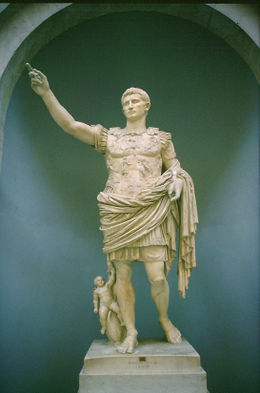
consul – n - An official appointed by the government of one country to look after its commercial interests and the welfare of its citizens in another country; either of the two chief magistrates of the ancient Roman republic.
Consul was the highest elective office in the Roman republic. The republic itself came to an end after the civil war following Julius Caesar's assasination. The victor, Octavian (63 B.C.-A.D. 14), took the name Augustus and the republic gave way to the empire. (The naval battle off the coast of Actium, 31 B.C., was the decisive victory in the civil war. Marc Antony and his main squeeze, Cleopatra, committed suicide, and that was effectively the end for the republic. In my opinion, Actium is one of the relatively few battles of historical importance.)
Wednesday, January 31, 2007
phalanx
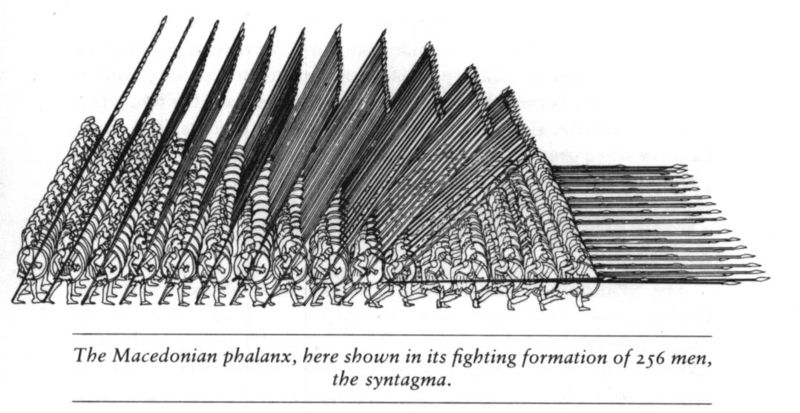
phalanx - noun - a group of heavily armed infantry formed in ranks and files close and deep with shields joined and long spears overlapping.
Inspired by today's word 'legion', I couldn't help but think quickly to come up with a similar military word. Indeed, I'm fascinated with ancient military weapons and tactics. I personally believe we have evolved to a point where warfare is 'clean' in so far as innocent bystanders are not targets and killing them is a veritable crime. So war has become a common occurrence, but we don't call it that. We call it military action. War is an atrocity. It should be fought with shields, spears and swords, up close so you know the man (or woman) you are killing. Raping and pillaging should be allowed as spoils to the victor. In such a climate, war once again becomes dirty and it's use as an extension of political or economic power becomes less commonplace. But I digress. Here is a quote which applies to today's word:
“Now of those, who dare, abiding one beside another, to advance to the close fray, and the foremost champions, fewer die, and they save the people in the rear; but in men that fear, all excellence is lost. No one could ever in words go through those several ills, which befall a man, if he has been actuated by cowardice. For ‘tis grievous to wound in the rear the back of a flying man in hostile war. Shameful too is a corpse lying low in the dust, wounded behind in the back by the point of a spear.” [Tyrtaeus: The War Songs Of Tyrtaeus]
exude
exude - v. - to ooze out; to undergo diffusion
I'm back!
I've read through all (most all, anyway) the words y'all posted on the days I missed. Great words! It really is amazing how many words we've been through...and how many more there are left! Yay!
BTW...maybe John is right and y'all do need me to keep you two honest. I saw those pictures (you know which ones I'm talking about)!
I'm back!
I've read through all (most all, anyway) the words y'all posted on the days I missed. Great words! It really is amazing how many words we've been through...and how many more there are left! Yay!
BTW...maybe John is right and y'all do need me to keep you two honest. I saw those pictures (you know which ones I'm talking about)!
legion
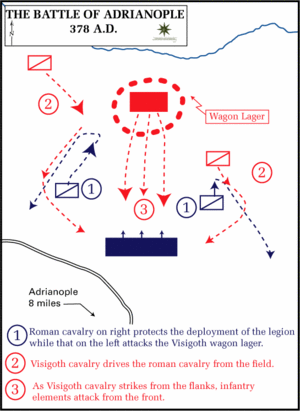
legion – n - A division of the Roman army, usually comprising 3000 to 6000 soldiers.
For centuries Rome had the best-trained, most efficient army the world had ever seen. They usually won, but there were at least two notable exceptions: in A.D. 9, Varus walked into a German ambush and lost three legions, and in A.D. 378 the emperor Valens took over 60% casualties against the Visigoths at Adrianople.
Jerry Pournelle noted that there have been only two extended periods of peace in history, the Pax Romana and the Pax Brittanica, and both were enforced by imperial military forces.
Tuesday, January 30, 2007
magnitude
magnitude - noun - Size; extent; great importance or consequence; a number characteristic of a quantity and forming a basis for comparison with similar quantities such as length; the brightness of a star or other celestial body as viewed by the unaided eye and expressed by a mathematical ration of 2.512: a star of the first magnitude is approximately 2.5 times as bright as one of the second magnitude and 100 times brighter than one of the sixth magnitude
I think that definition is long enough to not warrant commentary, don't you?
I think that definition is long enough to not warrant commentary, don't you?
factor
factor – A person who acts or transacts business for another; an agent entrusted with the possession of goods to be sold in the agent's name; a merchant earning a commission by selling goods belonging to others.
Obviously, the word has several definitions; I've given a couple that may be less familiar. In the ante-bellum South, such crops as cotton, tobacco, and indigo would be shipped overseas to a factor, who would then handle the sale. The factor might also purchase and ship back items that were not readily available in the states. This became a bone of contention in the states that eventually made up the Confederacy. Since the federal government in its pre-income-tax days was mostly financed by import tariffs, Southerners felt - with some justification - that they were bearing a disproportianate share of the burden.
Obviously, the word has several definitions; I've given a couple that may be less familiar. In the ante-bellum South, such crops as cotton, tobacco, and indigo would be shipped overseas to a factor, who would then handle the sale. The factor might also purchase and ship back items that were not readily available in the states. This became a bone of contention in the states that eventually made up the Confederacy. Since the federal government in its pre-income-tax days was mostly financed by import tariffs, Southerners felt - with some justification - that they were bearing a disproportianate share of the burden.
Monday, January 29, 2007
impatience
impatience - noun - eager desire for relief or change; restlessness; intolerance of anything that thwarts, delays or hinders.
This is listed as a virtue in programming circles. I found this article to be quite amusing and often accurate. Note the other virtues of programmers is hubris and laziness.
This is listed as a virtue in programming circles. I found this article to be quite amusing and often accurate. Note the other virtues of programmers is hubris and laziness.
decimate

decimate – v - To destroy a great number or proportion of; to select by lot and kill every tenth person of.
Both sides, Union and Confederate, were decimated on the single bloodiest day in American history, September 17, 1862. The scene was the ridges and fields west of Antietam Creek near Sharpsburg, Maryland. There were over 23,000 casualties, more than the total casualties for the War of 1812, the Mexican War, and the Spanish-American War combined. A sorrowful day indeed.
Friday, January 26, 2007
honorific

honorific - n - A title, phrase, or grammatical form conveying respect, used especially when addressing a social superior.
For example, a cardinal is addressed as "Your Eminence," a king as "Your Highness," etc.
And now I have some mournful news: Natalie has thrown in the towel; the co-founder of our institution is no longer with us. Ave Atque Vale, Natalia!
Thursday, January 25, 2007
 picture of a punty (click here)
punty - noun - an iron rod used in glassmaking for handling the hot glass.
You can't see it very well in this picture, but the rod in approximately the center of the picture running into the orange mass of glass is the punty. Glassblowing has always fascinated me. There used to be a glassblower in Colorado Springs which we used to visit from time to time, and I never wanted to leave. It was so exciting to watch the blow and manipulate the glass into such beautiful shapes.
limn

limn –v - To represent in drawing or painting; to portray in words; describe; to illuminate manuscripts.
I'm a big fan of the lost art of manuscript illumination. Here's a page from the Book of Kells (c. A.D. 800), a copy of the gospels produced by Irish monks.
Wednesday, January 24, 2007
inscrutable
inscrutable - adj - difficult to fathom or understand; difficult to be explained or accounted for satisfactorily; obscure; incomprehensible; impenetrable
Kind of like the Democratic response to the Presidents speech last night. Some of the comments, especially those related to the economy didn't make sense to me. Not because I'm not an economist, but because they seemed to be restating the same points the President made. Further, the comments related to the defense of the nation seemed more related to how his father had served a long tour, how he had served with the Marines, how his son was serving currently, more than a rebuttal of how the President was handling the situation in Iraq. I guess I'm just not cut out for political endeavors.
Kind of like the Democratic response to the Presidents speech last night. Some of the comments, especially those related to the economy didn't make sense to me. Not because I'm not an economist, but because they seemed to be restating the same points the President made. Further, the comments related to the defense of the nation seemed more related to how his father had served a long tour, how he had served with the Marines, how his son was serving currently, more than a rebuttal of how the President was handling the situation in Iraq. I guess I'm just not cut out for political endeavors.
patina
patina – n - A film or incrustation, usually green, produced by oxidation on the surface of old bronze and often esteemed as being of ornamental value; a similar film or coloring appearing gradually on some other substance; a surface calcification of implements, usu. indicating great age.
Subscribe to:
Posts (Atom)