privation - noun - an act or instance of depriving; the state of being deprived of something, especially of something required or desired; destitution; need.
What we might say of someone's obvious absence from this list (although, I'm similarly guilty this week - way too busy!)
Tuesday, October 03, 2006

blitzkrieg
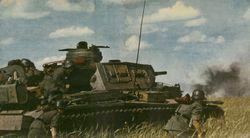
blitzkrieg - n - A swift, sudden military offensive, usually by combined air and mobile land forces.
Literally, "lightning war." Another German word that has entered the English-speakers vocabulary.
It wasn't known in 1939, but Germany threw virtually everything it had into its Polish invasion, which began September 1, 1939. Had Germany been attacked from the west at that time, the war in Europe may not have gone any further.
Monday, October 02, 2006
Weltanschauung
Weltanschauung - n - A comprehensive conception or image of the universe and of humanity's relation to it.
Another useful German word in common English usage.
And now, here's a question. I'm reading Tom Wolfe's novel I Am Charlotte Simmons, and I must say I'm appalled and disgusted by its picture of college life in the 21st Century. Co-ed dorms? Boys and girls together performing activities that should be private or at least confined to the same sex? Hooking-up, which means impromptu sex with someone you've just met? Courses designed to be "athlete friendly"? You've both been in college much more recently than I have, so I ask you: How much of this is true? (As for the novel, it's excellent - like every other Tom Wolfe book I've read, fiction or non-fiction. Caution: It's rated a very hard R, which couldn't be avoided given the subject.)
Friday, September 29, 2006
blandish
blandish - verb - to coax or influence by gentle flattery; cajole; to use flattery or cajolery.
No real commentary, but notice how much fun the word cajolery is to say...
No real commentary, but notice how much fun the word cajolery is to say...
dada
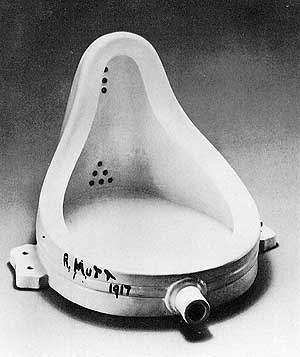
dada - n - the style and techniques of a group of artists, writers, etc., of the early 20th century who exploited accidental and incongruous effects in their work and who programmatically challenged established canons of art, thought, morality, etc.
The picture shows Marcel Duchamp's Fountain (1917), a prime example of dadaist "art."
To compensate, here's Edward Arlington Robinson's (1869-1935) best (in my opinion) poem:
Old Eben Flood, climbing alone one night
Over the hill between the town below
And the forsaken upland hermitage
That held as much as he should ever know
On earth again of home, paused warily.
The road was his with not a native near;
And Eben, having leisure, said aloud,
For no man else in Tilbury Town to hear:
"Well, Mr. Flood, we have the harvest moon
Again, and we may not have many more;
The bird is on the wing, the poet says,
And you and I have said it here before.
Drink to the bird."
He raised up to the light
The jug that he had gone so far to fill,
And answered huskily:
"Well, Mr. Flood,Since you propose it, I believe I will."
Alone, as if enduring to the end
A valiant armor of scarred hopes outworn,
He stood there in the middle of the road
Like Roland's ghost winding a silent horn.
Below him, in the town among the trees,
Where friends of other days had honored him,
A phantom salutation of the dead
Rang thinly till old Eben's eyes were dim.
Then, as a mother lays her sleeping child
Down tenderly, fearing it may awake,
He set the jug down slowly at his feet
With trembling care, knowing that most things break;
And only when assured that on firm earth
It stood, as the uncertain lives of men
Assuredly did not, he paced away,
And with his hand extended paused again:
"Well, Mr. Flood, we have not met like this
In a long time; and many a change has come
To both of us, I fear, since last it was
We had a drop together.
Welcome home!"
Convivially returning with himself,
Again he raised the jug up to the light;
And with an acquiescent quaver said:
"Well, Mr. Flood, if you insist, I might.
"Only a very little, Mr. Flood--For auld lang syne.
No more, sir; that will do."
So, for the time, apparently it did,
And Eben evidently thought so too;
For soon amid the silver loneliness
Of night he lifted up his voice and sang,
Secure, with only two moons listening,
Until the whole harmonious landscape rang--
"For auld lang syne."
The weary throat gave out,
The last word wavered; and the song being done,
He raised again the jug regretfully
And shook his head, and was again alone.
There was not much that was ahead of him,
And there was nothing in the town below--
Where strangers would have shut the many doors
That many friends had opened long ago.
Thursday, September 28, 2006
sanguine
sanguine - adj - Cheerfully optimistic, hopeful, or confident; reddish; ruddy.
It may also be used as a synonym for sanguinary, but I have never seen or heard it used that way.
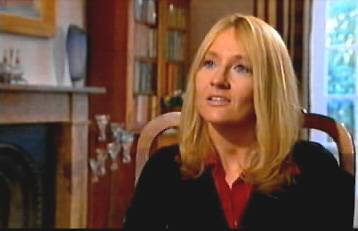
Tangent: I am just finishing E. L. Doctorow's novel The March, about Sherman's march through Georgia and the Carolinas, and I'm about to start Tom Wolfe's novel I Am Charlotte Simmons. I mention this because I suspect many people think I believe the novel is dead. There is some truth to that, especially when you consider the dim view I take of Stephen KIng and John Grisham, but I have read some good modern novels. A few that come to mind are The Bonfire of the Vanities and A Man in Full, both by Tom Wolfe, Lonesome Dove, by Larry McMurty, and The Mambo Kings Play Songs of Love (Rated X), by Oscar Hijuelos. I have also heard good things about J. K. Rowling's (the most photogenic of the lot, pictured here) Harry Potter novels (the last of which was selling 38,000 copies an hour at its peak!). So the novel isn't dead, but it's certainly in critical condition.
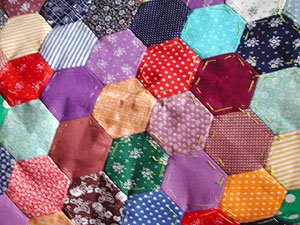
patchwork
patchwork - n. - something composed of miscellaneous or incongruous parts, hodgepodge; pieces of cloth of various colors and shapes sewn together to form a covering
Wednesday, September 27, 2006
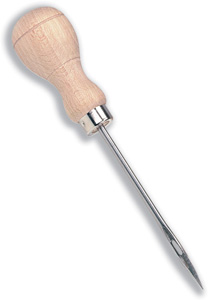
bodkin
bodkin - n. - a sharp slender instrument for making holes in cloth; a blunt needle with a large eye for drawing tape or ribbon through a loop or hem
recusant

recusant - n - One of the Roman Catholics in England who incurred legal and social penalties in the 16th century and afterward for refusing to attend services of the Church of England; A dissenter; A nonconformist.
Very little is known about Shakespeare's life, which has resulted in much speculation. For instance, there is the (mostly) discredited idea that he was a Catholic recusant.
A small but dedicated group believes that Shakespeare didn't write the plays attributed to him. The main candidates for the title of "real" Shakespeare are Francis Bacon and Edward de Vere, 17th Earl of Oxford. A couple of people I respect (Joseph Sobran and Michael Hart) believe Oxford was Shakespeare; Sobran has written a book, Alias Shakespeare, which argues the case for Oxford at some length.
My advice to both of you is, if you plan to attain historical fame, be sure to leave a large paper trail.
Tuesday, September 26, 2006
fulsome
fulsome - adj - offensive to the taste or sensibilities; insincere or excessively lavish; especially offensive from excess praise
satyriasis

satyriasis - n - A syndrome, occurring in males, of excessive preoccupation with sexual gratification or conquest and leading to persistently transient and sometimes exploitative relationships.
Today's word is rated PG-13! You'll notice that bit about "persistently transient and sometimes exploitative relationships," which makes satyriasis a characteristic disorder for our unhappy times. Needless to say - but I'll say it anyway - the antonym is nymphomania, which in spite of Cosmopolitan and other such magazines, is considerably less widespread.
bobbin
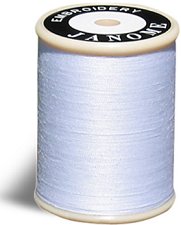
bobbin - n. - a cylinder or spindle on which yarn or thread is wound (as in a sewing machine), any of various small round devices on which threads are wound for working handmade lace; a cotton cord formerly used by dressmakers for piping
Bobbin and thread:
Bobbin and thread:
Monday, September 25, 2006
suttee
suttee - n - A Hindu practice whereby a widow immolates herself on the funeral pyre of her husband: now abolished by law.
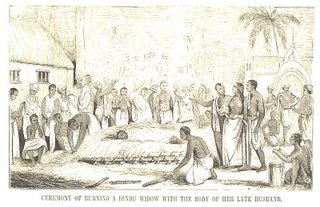 This wicked practice was outlawed by the English. The widow's immolation was supposed to be voluntary, but it's been much debated how great an influence social pressures played in her decision.
It's amazing the extent to which Franz Boaz's cultural relativism has become part of the collective consciousness. Allen Bloom told how his studentss could never bring themselves to condemn suttee; their most common opinion was that the English shouldn't have been there in the first place. I tried Bloom's experiment on a friend. "Were the English right to put a stop to this monstrous practice?" I asked. I'll bet you can guess his answer.
 This wicked practice was outlawed by the English. The widow's immolation was supposed to be voluntary, but it's been much debated how great an influence social pressures played in her decision.
It's amazing the extent to which Franz Boaz's cultural relativism has become part of the collective consciousness. Allen Bloom told how his studentss could never bring themselves to condemn suttee; their most common opinion was that the English shouldn't have been there in the first place. I tried Bloom's experiment on a friend. "Were the English right to put a stop to this monstrous practice?" I asked. I'll bet you can guess his answer.
darn
darn - v. - to mend with interlacing stitches; to embroider by filling with long running or interlacing stitches
Wikipedia is a little more descriptive:
Darning is a sewing technique for repairing holes or worn areas in fabric or knitting with needle and thread alone. It is often done by hand, but it is also possible to darn with a sewing machine. Hand darning employs the darning stitch, a simple running stitch in which the thread is "woven" in rows along the grain of the fabric, with the stitcher reversing direction at the end of each row.
Darning also refers to any of several needlework techniques worked in darning stitches:
Pattern darning is a type of embroidery that uses parallel rows of straight stitches of different lengths to create a geometric design.
Net darning, also called filet lace, is a 19th century technique using stitching on a mesh foundation fabric to imitate lace.
Needle weaving is a drawn thread work embroidery technique that involves darning patterns into barelaid warp or weft threads.
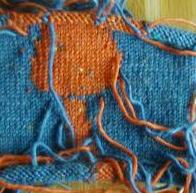
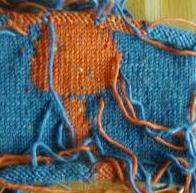
This picture didn't teach me anything, so I included it for a laugh. Apparently, this is a picture of "darning." Let me know if you can figure it out.
Wikipedia is a little more descriptive:
Darning is a sewing technique for repairing holes or worn areas in fabric or knitting with needle and thread alone. It is often done by hand, but it is also possible to darn with a sewing machine. Hand darning employs the darning stitch, a simple running stitch in which the thread is "woven" in rows along the grain of the fabric, with the stitcher reversing direction at the end of each row.
Darning also refers to any of several needlework techniques worked in darning stitches:
Pattern darning is a type of embroidery that uses parallel rows of straight stitches of different lengths to create a geometric design.
Net darning, also called filet lace, is a 19th century technique using stitching on a mesh foundation fabric to imitate lace.
Needle weaving is a drawn thread work embroidery technique that involves darning patterns into barelaid warp or weft threads.
This picture didn't teach me anything, so I included it for a laugh. Apparently, this is a picture of "darning." Let me know if you can figure it out.
Friday, September 22, 2006
shrew
shrew - n - A woman of violent temper and speech.
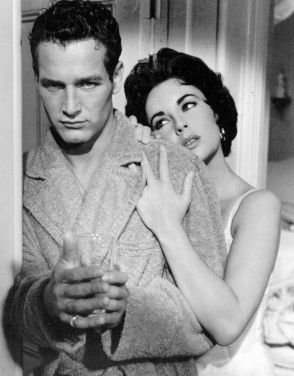
Guess which Shakespeare play is next on my list? I saw the movie, starring Richard Burton and Elizabeth Taylor, in 1967. Burton in Elizabethan costume brought down the house. (There was a popular misconception that Elizabeth Taylor was just another pretty face. She certainly was pretty, but she was also a first-rate actress, as you can see in such movies as Raintree County, Cat on a Hot Tin Roof (left, with Paul Newman), Suddenly Last Summer, and Who's Afraid of Virginia Woolf?)
Subscribe to:
Posts (Atom)