rindle - noun - a small water course or gutter
Today, I start a series of words from Charles MacKay's Lost Beauties of the English Language which I find fascinating. MacKay generated his own short list of words in a rudimentary dictionary which was sold in the 1870's. He had a rather pedantic view that a nation's barbarous language was an indication of the barbarousness of the nation as a whole, and he set about to change that. His dictionary was, perhaps in his view, a call to return to some of the less used, but beautiful words of the English language.
Friday, February 09, 2007

ante-bellum

ante-bellum - adj - Latin, lit. "before-the-war," in U.S., usually in ref. to American Civil War (1861-65).
Even my feeble Latin can handle this one: Ante = before, bellum = war. One thing I have retained from my high school Latin is an appreciation for Latin (and Greek) as an English vocabulary builder. Take 'bellum' as an example; what do you think the English word 'bellicose' might mean? Or to give just one more example out of thousands I could produce, how about 'culina' (kitchen)? Does culinary ring any bells? I realize I'm preaching to the choir here, and nothing I've written will be new to you, but it's a good thing to keep in mind when you're teaching your children.
As for the ante-bellum period in our misnamed Civil War, which I say runs from 1846-1861, the book to read is David Potter's The Impending Crisis. (1846 is the year the Mexican War began. What makes it the starting point for the events leading up to the central event in our history was tobacco-chomping, whiskey-guzzling, Pennsylvania congressman David Wilmot's proviso to a bill to provide funding for purchase of land acquired from Mexico; it stated that slavery was to be forbidden in all such purchased lands. The proviso was defeated, but it was the first in a sad chain of events that include the Compromise of 1850, the Fugitive Slave Act of 1852, the Kansas-Nebraska bill, the founding of the Republican Party in 1856, Dredd Scott vs. Sanford, the border war between Kansas and Missouri, the Lincoln-Douglas debates, John Brown's raid on Harper's Ferry, the splitting of the Democratic Party in 1860, the election of Abraham Lincoln, and the secession of South Carolina in December, 1860, followed by secession of the six Gulf states.) (Yes, I know I indulged in some ad hominems above, but I'll stand by them.)
Thursday, February 08, 2007
depravity
depravity - noun - moral perversion; impairment of virtue and moral principles; a corrupt or degenerate act or practice.
You know, like the Democrats. Okay, sorry, I'll refrain from the political statements. I just couldn't resist that one. Anyway, this is sort of a dovetail on Natalie's uncommented word theme from earlier.
You know, like the Democrats. Okay, sorry, I'll refrain from the political statements. I just couldn't resist that one. Anyway, this is sort of a dovetail on Natalie's uncommented word theme from earlier.
Wednesday, February 07, 2007
modus vivendi

modus vivendi - n - A manner of living; a way of life; A temporary agreement between contending parties pending a final settlement.
This is a Latin term I find myself using more frequently in these unhappy times.
Now, completely off topic: What's with the current rash of militant, even vitriolic, atheism? I'm talking about the recent bestsellers by Sam Harris and Richard Dawkins (not to mention their TV appearances), Philip Pullman's prize-winning His Dark Materials trilogy, and the pathological and often obscene ravings of such as Amanda Marcotte (today's picture). I can understand their disbelief - there was a time when I shared it - but I can't understand their hatred. Any thoughts?
missive
missive - noun - a written message; a letter
'Tis the season for these. Send an amorous instance to your sweetheart!
'Tis the season for these. Send an amorous instance to your sweetheart!
resale
resale - n. - the act of selling again usually to a new party; a secondhand sale, an additional sale to the same buyer
Ahhh, resale shops! My favorite t-shirts are all from resale shops. They are soft, worn-in, and usually one-of-a-kind. Now wearing vintage is the "new thing." Those vintage stores in the mall charge ridiculous amounts for those clothes. I can understand paying a lot for the last original shirt from some rock concert in the '70s... but all that other stuff? ...nah, I'll stick to the good 'ole resale shops.
On another note, I stand behind my word for Monday. I may have used a different form of it before, but I think we've allowed for different word endings in the past. Perhaps I'm being licentious? I will search the spreadsheet a little more closely in the future, though.
Also, I added a word for yesterday. It's late, but it's there!
Ahhh, resale shops! My favorite t-shirts are all from resale shops. They are soft, worn-in, and usually one-of-a-kind. Now wearing vintage is the "new thing." Those vintage stores in the mall charge ridiculous amounts for those clothes. I can understand paying a lot for the last original shirt from some rock concert in the '70s... but all that other stuff? ...nah, I'll stick to the good 'ole resale shops.
On another note, I stand behind my word for Monday. I may have used a different form of it before, but I think we've allowed for different word endings in the past. Perhaps I'm being licentious? I will search the spreadsheet a little more closely in the future, though.
Also, I added a word for yesterday. It's late, but it's there!
Tuesday, February 06, 2007
conspectus
conspectus - noun - a general sketch or survey of a subject
John is particularly good with this word. Consider all the times he has provided the list with interesting information over some topic related (and sometimes not) to the word he posts. Props to you, my friend.
John is particularly good with this word. Consider all the times he has provided the list with interesting information over some topic related (and sometimes not) to the word he posts. Props to you, my friend.
lewd
lewd - adj. - sexually unchaste or licentious
This concludes my theme of words (for now) that restrict commentary.
This concludes my theme of words (for now) that restrict commentary.
Monday, February 05, 2007
misnomer
misnomer – n - A misapplied or inappropriate name or designation; an error in naming a person or thing.
Friday, February 02, 2007
lechery
lechery - n. - inordinate indulgence in sexual activity
This word and yesterday's word create my theme for the next few days. While themes are good, unfortunately the nature of this particular theme keeps me from commentary.
We gotta keep this thing clean!
This word and yesterday's word create my theme for the next few days. While themes are good, unfortunately the nature of this particular theme keeps me from commentary.
We gotta keep this thing clean!
tribune
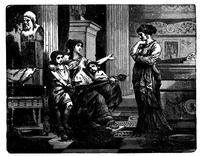
tribune – n - A person who upholds or defends the rights of the people; (Roman History) any of various administrative officers, esp. one of 10 officers elected to protect the interests and rights of the plebeians from the patricians.
In other words, a tribune's job was to represent the commoners and to intervene on their behalf with the elites. (A tribune might also have been one of six officers who took turns commanding a legion, but the definition I've given is what's generally understood.) The most famous tribunes in Roman history were the Gracchus brothers, Tiberius (163-133 B.C.) and Gaius (159-121 B.C.), both of whom ran afoul of the Senate and paid with their lives. Their mother, Cornelia (pictured above), became a venerated figure for having produced two such men of the people.
Thursday, February 01, 2007
cohort
cohort - noun - a body of about 300 to 600 soldiers; the tenth part of a legion; any group or body of warriors; a group or band of people; a companion; an associate
I wrote the definition for this word in reverse order. The obsolete version is the first definition I give and it follows along the lines of my previous word. (For the moment we seem to be interested in Roman history!) Anyway, a cohort was the more mobile infantry that was used to outflank a phalanx on several occasions as the Romans were starting to dominate their world. One of the reasons the Spartans were able to be nearly invincible in wartime was their complete lack of fear when facing the enemy as well as their incredible discipline and hard training. They managed to win in phalanx battles, often out of intimidation as much as anything. The Romans had most of the same characteristics. They were fearless in battle and more disciplined than any army of it's time (or maybe even since!). However, they brought a higher degree of mobility and speed to warfare (as well as effective battle formations) so they could defeat enemies even though out numbered. That's not to say they didn't use some of the more common forms of war (like the phalanx), they just seemed to do it better or faster.
I wrote the definition for this word in reverse order. The obsolete version is the first definition I give and it follows along the lines of my previous word. (For the moment we seem to be interested in Roman history!) Anyway, a cohort was the more mobile infantry that was used to outflank a phalanx on several occasions as the Romans were starting to dominate their world. One of the reasons the Spartans were able to be nearly invincible in wartime was their complete lack of fear when facing the enemy as well as their incredible discipline and hard training. They managed to win in phalanx battles, often out of intimidation as much as anything. The Romans had most of the same characteristics. They were fearless in battle and more disciplined than any army of it's time (or maybe even since!). However, they brought a higher degree of mobility and speed to warfare (as well as effective battle formations) so they could defeat enemies even though out numbered. That's not to say they didn't use some of the more common forms of war (like the phalanx), they just seemed to do it better or faster.
randy
randy - adj. - lustful, lecherous
New word for me. As far as I knew, this was just a name for a guy. It makes me look at all the Randys I know just a little bit differently (I know it's not their fault, but still!).
New word for me. As far as I knew, this was just a name for a guy. It makes me look at all the Randys I know just a little bit differently (I know it's not their fault, but still!).
consul
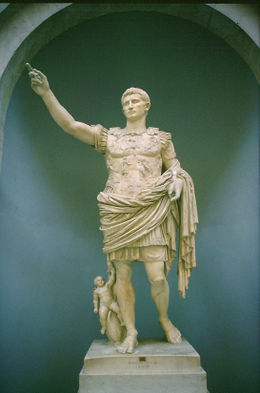
consul – n - An official appointed by the government of one country to look after its commercial interests and the welfare of its citizens in another country; either of the two chief magistrates of the ancient Roman republic.
Consul was the highest elective office in the Roman republic. The republic itself came to an end after the civil war following Julius Caesar's assasination. The victor, Octavian (63 B.C.-A.D. 14), took the name Augustus and the republic gave way to the empire. (The naval battle off the coast of Actium, 31 B.C., was the decisive victory in the civil war. Marc Antony and his main squeeze, Cleopatra, committed suicide, and that was effectively the end for the republic. In my opinion, Actium is one of the relatively few battles of historical importance.)
Wednesday, January 31, 2007
phalanx
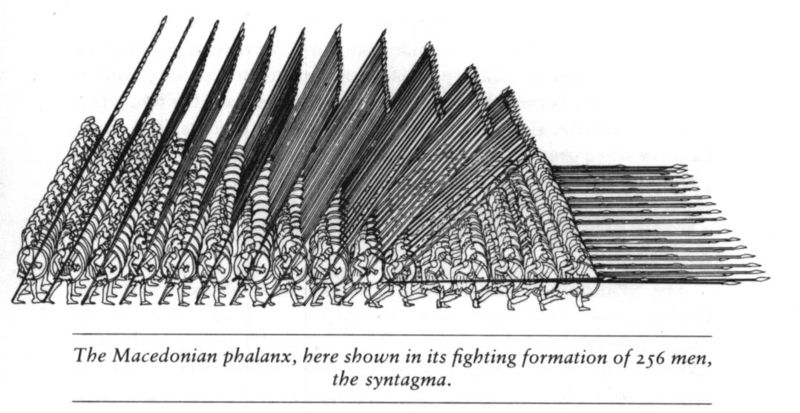
phalanx - noun - a group of heavily armed infantry formed in ranks and files close and deep with shields joined and long spears overlapping.
Inspired by today's word 'legion', I couldn't help but think quickly to come up with a similar military word. Indeed, I'm fascinated with ancient military weapons and tactics. I personally believe we have evolved to a point where warfare is 'clean' in so far as innocent bystanders are not targets and killing them is a veritable crime. So war has become a common occurrence, but we don't call it that. We call it military action. War is an atrocity. It should be fought with shields, spears and swords, up close so you know the man (or woman) you are killing. Raping and pillaging should be allowed as spoils to the victor. In such a climate, war once again becomes dirty and it's use as an extension of political or economic power becomes less commonplace. But I digress. Here is a quote which applies to today's word:
“Now of those, who dare, abiding one beside another, to advance to the close fray, and the foremost champions, fewer die, and they save the people in the rear; but in men that fear, all excellence is lost. No one could ever in words go through those several ills, which befall a man, if he has been actuated by cowardice. For ‘tis grievous to wound in the rear the back of a flying man in hostile war. Shameful too is a corpse lying low in the dust, wounded behind in the back by the point of a spear.” [Tyrtaeus: The War Songs Of Tyrtaeus]
exude
exude - v. - to ooze out; to undergo diffusion
I'm back!
I've read through all (most all, anyway) the words y'all posted on the days I missed. Great words! It really is amazing how many words we've been through...and how many more there are left! Yay!
BTW...maybe John is right and y'all do need me to keep you two honest. I saw those pictures (you know which ones I'm talking about)!
I'm back!
I've read through all (most all, anyway) the words y'all posted on the days I missed. Great words! It really is amazing how many words we've been through...and how many more there are left! Yay!
BTW...maybe John is right and y'all do need me to keep you two honest. I saw those pictures (you know which ones I'm talking about)!
legion
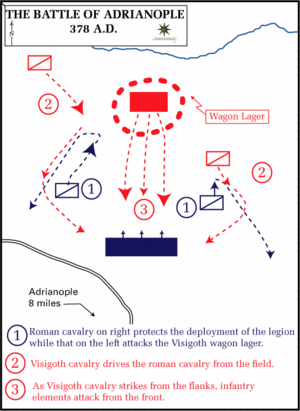
legion – n - A division of the Roman army, usually comprising 3000 to 6000 soldiers.
For centuries Rome had the best-trained, most efficient army the world had ever seen. They usually won, but there were at least two notable exceptions: in A.D. 9, Varus walked into a German ambush and lost three legions, and in A.D. 378 the emperor Valens took over 60% casualties against the Visigoths at Adrianople.
Jerry Pournelle noted that there have been only two extended periods of peace in history, the Pax Romana and the Pax Brittanica, and both were enforced by imperial military forces.
Tuesday, January 30, 2007
magnitude
magnitude - noun - Size; extent; great importance or consequence; a number characteristic of a quantity and forming a basis for comparison with similar quantities such as length; the brightness of a star or other celestial body as viewed by the unaided eye and expressed by a mathematical ration of 2.512: a star of the first magnitude is approximately 2.5 times as bright as one of the second magnitude and 100 times brighter than one of the sixth magnitude
I think that definition is long enough to not warrant commentary, don't you?
I think that definition is long enough to not warrant commentary, don't you?
Subscribe to:
Posts (Atom)